No grout lines to scrub
Because the floor is poured as one surface, there are no joints collecting dirt the way tile grout does. Daily care is usually a dust mop and a weekly damp mop with a neutral cleaner.
Traditional terrazzo installation · Bellflower, California
Pacific Coast Terrazzo installs traditional terrazzo: chips of marble, quartz, granite, and glass set in cement, then ground and polished until the whole floor reads as one seamless surface.
The material
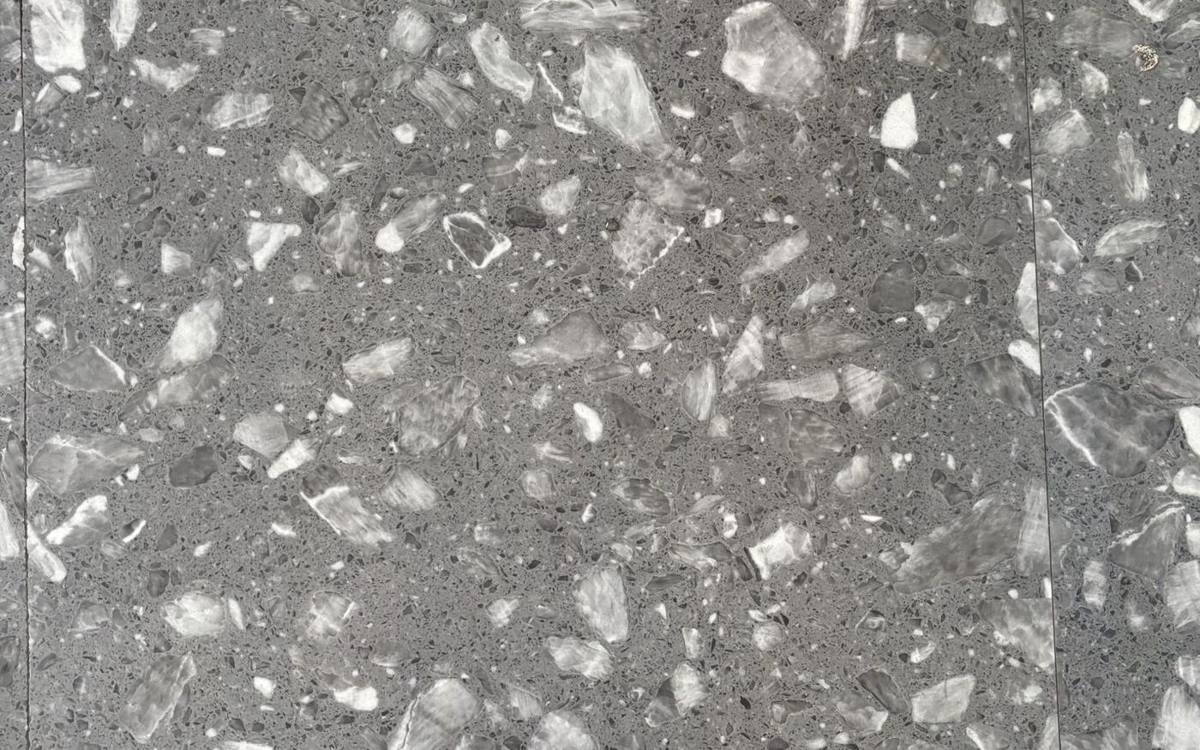
Terrazzo is not a print or a tile pattern. It is a poured surface: loose stone chips bound in cement, cured, then ground flat and polished. What you walk on is real stone, all the way through.
Chip tones like these are the palette of traditional terrazzo. A floor can run nearly one color, or carry a scattered mix across the whole room. Thin metal divider strips separate one field from the next, the same strips you see marking the bands on this page.
The craft
Four passes turn loose stone into a floor. This is the traditional method, the one Pacific Coast Terrazzo is named for.
Stone chips are mixed with cement and poured in place, divided into fields by metal strips that will later read as fine lines in the finished floor.
The pour is left to set and cure until the cement has bound the chips into a single solid slab.
Grinders cut the surface flat, exposing the chips and leveling the whole field to one even plane.
Successive finer passes polish the floor to its finish, then it is cleaned and sealed. The result is a surface with no grout lines and no separate pieces.
Why it endures
Because the floor is poured as one surface, there are no joints collecting dirt the way tile grout does. Daily care is usually a dust mop and a weekly damp mop with a neutral cleaner.
The color and pattern are not a surface layer. Grinding and polishing expose fresh stone, so wear does not rub the look away the way a coating can.
Terrazzo has floored schools, hospitals, airports, and homes for generations. The same material suits a quiet hallway and a room that takes daily foot traffic.
Service area
Based in Bellflower, California.
Project areas, scheduling, and quotes go through the business directly. Use the contact form on their site to start that conversation.
Questions
Stone chips set in a cement base, poured in place, cured, ground flat, and polished. It is a poured floor, not tile and not a coating.
Tile is made of separate pieces with grout joints between them. Terrazzo is one continuous surface, so there are no joints to crack, stain, or scrub.
Generally, daily dust mopping and a weekly damp mop with a neutral cleaner are enough. Avoid harsh acidic cleaners, which can dull a cement-based floor over time.
Anywhere a hard, seamless floor makes sense: entries, kitchens, living areas, and commercial spaces. It has a long history in schools, hospitals, and airports for the same reason.
Through the contact form on the Pacific Coast Terrazzo site. The business lists no phone number, so the form is the way to reach them.
Contact
Tell Pacific Coast Terrazzo about your space and your project through the form on their site.
Pacific Coast Terrazzo lists no phone number. This page carries none either, on purpose.